
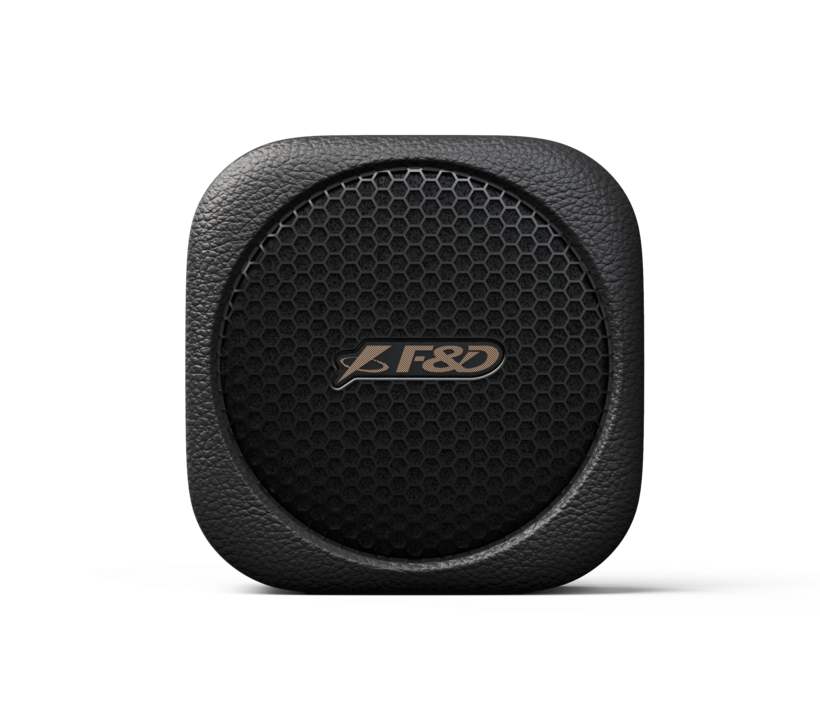
In the portable speaker market, Marshall has long been a "sentimental choice" for many music lovers, thanks to its retro British design and classic sound quality. Meanwhile, Fenda, a brand deeply rooted in the audio industry, has been gaining market share with cost-effective products. Today, we’ll focus on the Fenda RW10 portable speaker and compare it with Marshall’s popular portable models (taking the Marshall Emberton II as an example) in terms of core configurations, usage scenarios, and cost-effectiveness. This comparison will help you find the perfect "portable sound companion" that suits your needs.
I. Core Configurations: Practical Functions vs. Classic Tuning
Both speakers are positioned as "portable on-the-go devices," but they differ significantly in hardware configurations and functional design, which directly impact the user experience and sound performance.
| Configuration Dimension | Fenda RW10 | Marshall Emberton II |
|---|---|---|
| Connection Methods | Supports Bluetooth 5.3, TF card direct playback, USB sound card mode (TYPE-C data cable), and TWS pairing (compatible with Fenda’s retro-series model RW20) | Only supports Bluetooth 5.1; no TF card/USB sound card mode; TWS pairing limited to the same model |
| Sound Units | 1.75-inch customized full-frequency speaker + 2 passive radiators | 2-inch full-frequency speaker + 1 passive radiator |
| Battery Life | Up to 10 hours of playback (official data) | Up to 20 hours of playback (official data) |
| Protection Rating | Not clearly specified (presumed to have no IP rating, more suitable for indoor/dry environments) | IPX7 water resistance (can withstand short-term submersion, ideal for outdoor use, bathrooms, etc.) |
From the configuration perspective, the Fenda RW10 prioritizes "versatility." TF card direct playback is convenient for scenarios without a smartphone (e.g., for the elderly or children), while the USB sound card mode allows it to be used as an external speaker for computers. The cross-model TWS pairing (supporting RW20) also enhances flexibility in combination. On the other hand, the Marshall Emberton II excels in "battery life and protection." Its 20-hour battery life meets all-day outdoor use needs, and the IPX7 water resistance makes it resistant to rain and splashes, making it suitable for camping, sports, and other activities.
II. Sound Performance: Balanced Sound vs. Rock DNA
Sound quality is the core of a speaker, and the two products have distinct tuning styles, catering to users with different music preferences.
Equipped with a 1.75-inch customized full-frequency unit and 2 passive radiators, the Fenda RW10 leans toward a "balanced and natural" tuning. Its mid-range is clear, with high vocal reproduction (perfect for pop, folk, and audiobooks). The low-frequency is enhanced by the passive radiators – while it doesn’t deliver overwhelming impact, the bass depth is moderate and won’t overshadow mid-high frequency details. The high-frequency performance is decent, with no harsh distortion, making it suitable for daily "casual listening," such as enjoying music during commutes or using it as background sound in the office.
The Marshall Emberton II, on the other hand, continues the brand’s "rock DNA." The 2-inch full-frequency unit produces stronger low frequencies, with distinct impact from drumbeats and bass – ideal for rock, electronic, and hip-hop music that emphasizes heavy bass. The mid-range is slightly thinner, but vocals remain clear. The high-frequency brightness is somewhat weak, but this aligns with Marshall’s "warm sound" tuning style. When listening to classic old songs or live rock performances, it creates a more immersive atmosphere.
In short: If you’re an "all-genre listener" who enjoys various types of music and values natural, balanced sound, the Fenda RW10 is more than sufficient. If you’re a fan of rock and heavy bass, and crave strong low-frequency impact and atmosphere, the Marshall Emberton II will be a better fit.
III. Design & Portability: Retro Minimalism vs. British Recognition
The design of a portable speaker not only affects its appearance but also its grip and portability.
The Fenda RW10 follows a "retro minimalist" style (inferred from its compatibility with the same-series RW20). While its exact dimensions aren’t specified, the 1.75-inch unit suggests it’s a "compact and portable" model – lightweight, easy to hold with one hand, and fits easily into backpacks or pockets. It likely comes in classic colors like black, white, and wood tones, with no excessive decorations. Its low-key design makes it suitable for daily use without being ostentatious.
The Marshall Emberton II is a representative of "British recognition": its square body, brand logo on the metal mesh cover, and retro leather handle (on some versions) make it instantly recognizable. It has strong "social appeal" in terms of appearance – whether held in hand or placed on a table, it stands out. However, its body is slightly thicker and weighs approximately 0.7kg. While still portable, it’s a bit more tiring to hold for long periods compared to the RW10.
If you prefer "low-key practicality" and don’t want your device to stand out too much, the Fenda RW10 is a better choice. If you value "appearance and brand tone" and like to express your personality through your devices, the Marshall Emberton II’s retro British design will be more appealing.
IV. Cost-Effectiveness: Budget-Friendly Practical Choice vs. Premium Sentimental Choice
Price is a key "decision factor" for many users, and the two products fall into significantly different price ranges (based on typical market prices):
As a cost-effective domestic product, the Fenda RW10 is likely priced in the 200-400 RMB range. At this price point, it offers features like Bluetooth 5.3, TF card/USB sound card support, and TWS pairing, delivering excellent cost-effectiveness. It’s ideal for budget-conscious users who prioritize "practicality," such as students, renters, or those in need of a "second backup speaker."
The Marshall Emberton II, on the other hand, is priced in the 1000-1500 RMB range – 3-4 times more expensive than the RW10. Beyond its advantages in sound quality, battery life, and water resistance, its price also includes brand premium and sentimental value. It’s suitable for users with sufficient budgets who pursue "brand tone and quality," such as Marshall fans or music lovers with high demands for sound quality and design.
V. Conclusion: Which Is Right for You?
Finally, we’ll provide "scenario-based recommendations" to help you make a quick decision:
Choose the Fenda RW10 if:
- Your budget is under 400 RMB, and you prioritize cost-effectiveness;
- You need multi-scenario usage (TF card music playback, computer sound card, TWS pairing);
- You prefer balanced, natural sound and mainly listen to pop, folk, or audiobooks daily;
- You favor a low-key, minimalist design and don’t want your device to be too eye-catching.
Choose the Marshall Emberton II (or other Marshall portable models) if:
- Your budget is over 1000 RMB, and you pursue brand reputation and quality;
- You frequently use speakers outdoors and need long battery life (20 hours) and IPX7 water resistance;
- You love rock and heavy bass music and crave strong low-frequency atmosphere;
- You value the recognizability of appearance and enjoy retro British-style design.
In conclusion, the Fenda RW10 is a "cost-effective choice for pragmatists," covering multi-scenario needs at a limited budget. Marshall, on the other hand, is a "representative of sentiment and quality," suitable for users willing to pay for brand, design, and specific sound styles. Choosing based on your budget and needs is always the right decision.